Building a business website is no longer a task that automatically requires a large budget, advanced coding knowledge, or months of preparation. AI website builders have made it possible to create a basic website by describing your business, choosing a design, and editing automatically generated content.
For many entrepreneurs, this offers an attractive way to establish an online presence without hiring a full development team. However, creating a website and creating one that consistently supports business growth are two different things.
A website may need to attract qualified visitors, turn enquiries into leads, support online payments, integrate with business software, or provide customers with a smooth digital experience. These requirements can make the choice between an AI website builder and a professional web development agency more important than it initially appears.
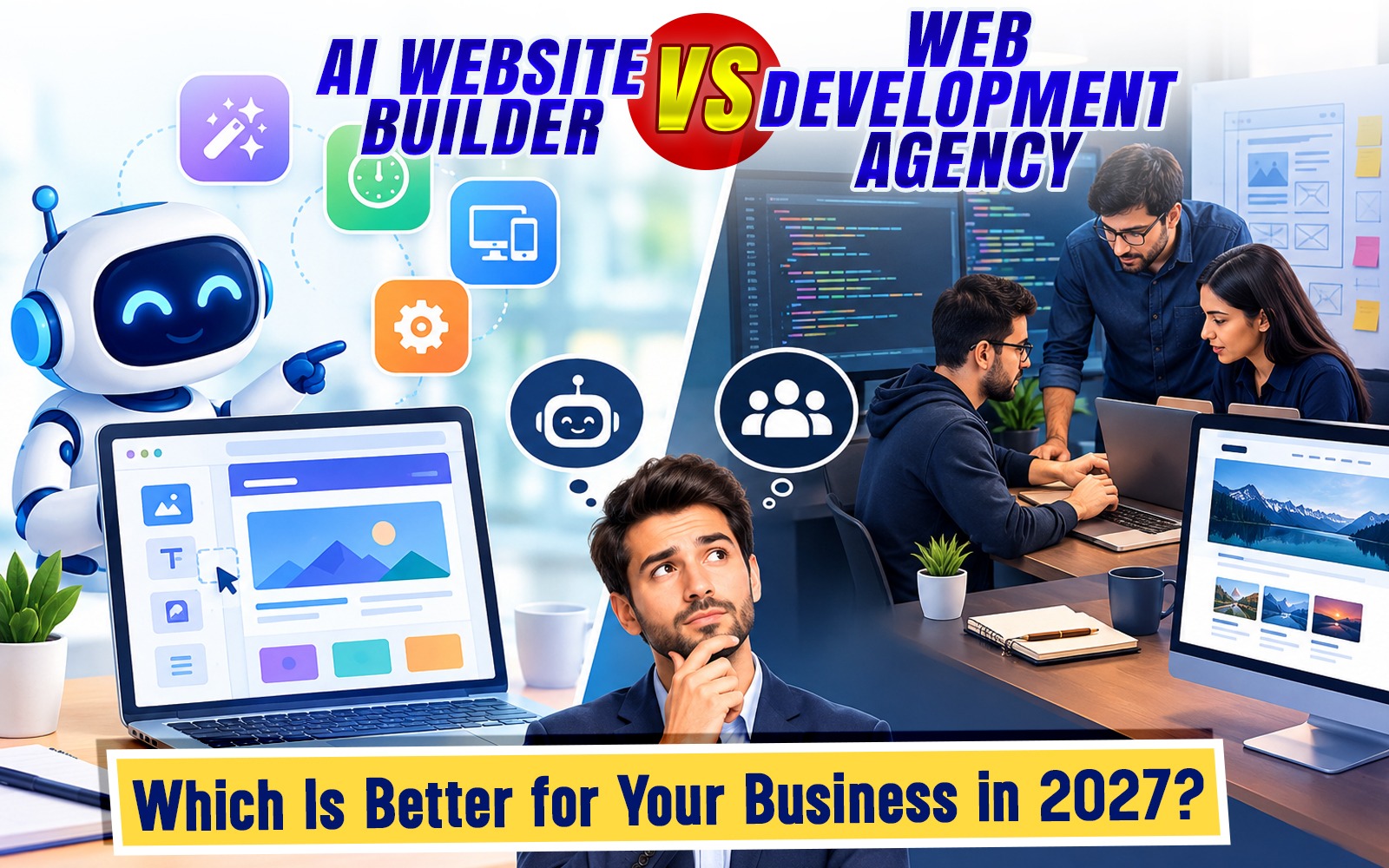
As businesses plan for 2027, the decision is becoming less about whether AI can build a website and more about which approach delivers the right results over time.
In this guide, Asteeri Infotech explores the differences between AI website builders and web development agencies to help you choose a solution that matches your budget, business goals, and plans for growth.
What Is an AI Website Builder?
An AI website builder is a platform that uses artificial intelligence to help users create websites with limited or no coding experience. Instead of building every page manually, users can describe their requirements and allow the platform to generate a starting design.
Depending on the platform, these tools can create page layouts, suggest colour schemes, write initial website copy, generate images, and provide basic features such as contact forms, blogs, and online stores.
For example, a small consulting business could request a website with a homepage, service descriptions, an enquiry form, and customer testimonials. The AI tool can generate an initial version that the business owner can then customize.
Advantages of AI Website Builders
AI website builders make it easier for businesses to establish an online presence without extensive coding knowledge or a large initial investment. They simplify the website creation process by automating design, generating content, and providing ready-made features.
For startups and small businesses, these tools offer a practical way to launch a website quickly and manage basic updates with minimal technical assistance.
1. Faster website creation
One of the biggest advantages is speed. A simple website can often be generated within minutes or hours, although preparing content, checking functionality, and completing the launch may take longer.
This can be helpful for startups and entrepreneurs who want to test a business idea before investing heavily in their online presence.
2. Lower initial investment
AI website builders generally have lower upfront costs than fully customized development projects. Many operate through subscription plans that combine website editing, hosting, and other services.
For businesses with limited budgets, this can make launching a website more accessible.
3. Easy content and design editing
Most platforms provide visual editing tools that allow users to change headings, images, colours, and page sections without writing code.
AI-assisted features can also help generate draft content and suggest alternative layouts when the business needs a quick update.
4. Suitable for straightforward requirements
A freelancer, consultant, local shop, or small service provider may only need a few pages explaining what they offer and how customers can contact them. An AI builder can be sufficient when these requirements are met by the platform's existing features.
Limitations of AI Website Builders
The convenience of AI website creation comes with certain trade-offs.
Generated content may sound generic, and suggested designs may resemble websites created with the same platform. Businesses still need to check factual accuracy, accessibility, mobile usability, page speed, and the quality of the customer journey.
Advanced integrations and specialised features may also be difficult or impossible to implement within a platform's available options.
Another consideration is platform dependency. Moving a website to another provider may require rebuilding some or all of its functionality, depending on how the original site was created.
An AI builder is therefore a useful starting point, but it should not be assumed to be a complete solution for every business requirement.
What Is a Web Development Agency?
A web development agency is a professional team that plans, designs, develops, tests, and maintains websites according to a client's business objectives. Depending on the agency, its services may include website strategy, user experience design, custom development, search engine optimization, e-commerce implementation, and ongoing technical support.
Rather than relying entirely on a predefined template, an agency evaluates what the website needs to accomplish and selects an appropriate approach.
For example, a growing top web development company may require a website that connects with a customer relationship management system, supports appointment scheduling, tracks enquiries, and provides different experiences for different customer groups.
A development agency can assess these requirements and build a solution around them.
Advantages of Hiring a Web Development Agency
Hiring a web development agency gives businesses access to professional expertise, customised solutions, and strategic guidance throughout the website development process. Beyond creating an attractive design, an experienced team can build a website around your business goals, target audience, and long-term growth plans.
This approach is particularly valuable for businesses that need advanced functionality, reliable integrations, strong SEO foundations, and a website that can evolve as their needs change.
1. Website design aligned with your brand
A professional agency can develop a visual identity and page structure around your business rather than simply adapting a standard layout.
This allows the website to communicate your services, values, and competitive advantages more clearly.
2. Custom functionality and integrations
Agencies can develop features that go beyond standard website builder capabilities. These may include custom booking systems, customer dashboards, payment integrations, inventory management, or connections with existing business software. The final scope depends on the agency's technical capabilities and the agreed project requirements.
3. Strategic SEO implementation
A website intended to generate organic traffic needs more than attractive pages. It also requires useful content, a logical information structure, appropriate metadata, crawlable links, and a clear approach to internal linking. An agency with SEO expertise can consider these elements during planning and development rather than treating them as an afterthought.
4. Support for future growth
Business requirements rarely remain unchanged. New services, additional locations, larger product catalogues, and more sophisticated customer journeys can all create new technical demands. A well-planned website can accommodate these changes without requiring a complete rebuild every time the business evolves.
5. Professional testing and maintenance
Depending on the service agreement, an agency can help identify technical issues, test forms and integrations, monitor performance, and maintain the website after launch.
However, these benefits depend on the agency's quality and the services included in the contract. Custom development alone does not guarantee better performance, stronger security, or higher rankings.
AI Website Builder vs Web Development Agency: Key Differences
Both AI website builders and web development agencies can create functional business websites, but they differ in cost, development time, flexibility, and long-term support.
AI website builders are generally more affordable and faster for launching simple websites, with ready-made templates and editing tools that require minimal technical knowledge. However, their design options, integrations, and scalability depend on the platform's capabilities.
In contrast, a web development agency typically requires a higher initial investment and a longer development timeline but can provide customized designs, advanced functionality, tailored SEO strategies, and integrations with existing business systems.
Maintenance and website ownership also vary depending on the platform's terms or the agency's contract. Ultimately, an AI website builder is often suitable for businesses with straightforward needs, while a web development agency may be a better fit for companies seeking customised solutions and long-term digital growth.
1. Cost: Is an AI Website Builder Always Cheaper?
AI website builders usually have an advantage when comparing initial expenses. A business can often launch a basic website without paying for a separate design and development project. However, the subscription price is only one part of the total cost.
Depending on the platform, additional expenses may include premium templates, third-party applications, e-commerce features, extra storage, or specialist assistance. The business owner must also account for the time spent editing content, resolving problems, and maintaining the site.
A development agency generally requires a larger initial investment because the project may involve research, design, coding, testing, and deployment. In return, the business receives a solution developed around an agreed scope.
To compare both options fairly, consider the total cost over two or three years, including subscriptions, hosting, maintenance, future changes, and any eventual migration.
Best choice: An AI builder is often suitable for a simple website with predictable needs. An agency may offer better value when specialised features or frequent technical changes would otherwise require expensive workarounds.
2. SEO: Which Option Is Better for Google Visibility?
Search engine optimization is a major consideration for businesses that depend on customers finding them online. An AI website builder may provide useful SEO controls, including editable page titles, meta descriptions, heading structures, and sitemap functionality. These features can support a sound SEO foundation when used correctly.
However, the presence of SEO tools does not mean a website is automatically optimised. Businesses must still publish relevant information, organise their pages logically, create useful internal links, address indexing issues, and provide a good experience on mobile devices.
A professional development agency can offer more control over technical implementation when the project requires custom URL structures, complex redirects, structured data, performance improvements, or advanced integrations.
That flexibility can be particularly useful for companies competing in demanding search markets or managing large websites.
Nevertheless, Google does not automatically favour a website because an agency built it. A well-maintained builder website can outperform a poorly developed custom website. Rankings depend on many factors, including content quality, relevance, technical accessibility, and the overall usefulness of the site.
Best choice: Both options can support SEO. Consider an agency when your search strategy requires technical expertise, extensive content planning, or more control over the website's architecture.
3. Design and User Experience: Templates or Tailored Solutions?
A website is often one of the first places potential customers interact with a business. Its design should make it easy for visitors to understand the offer, find relevant information, and take the next step.
AI builders can create attractive layouts quickly, particularly for businesses with standard requirements. However, the available design controls may restrict how far the website can depart from the platform's predefined patterns.
A development agency can study the target audience, prioritise important information, and build page layouts around specific customer journeys.
For example, a local service provider may need prominent phone and enquiry options, while an online retailer may need a product comparison experience and a streamlined checkout process.
These are not merely visual differences. The way information is presented can influence whether visitors understand the offer and complete the intended action.
Best choice: Use an AI builder when a clean, conventional design meets your needs. Consider an agency when the website must communicate a distinctive brand or support a carefully planned customer experience.
4. Functionality and Integrations: What Happens When Your Business Grows?
A basic website may initially require only service pages and a contact form. Over time, the business might need automated bookings, payment processing, customer accounts, inventory synchronisation, or connections to internal systems.
AI website builders can support many common functions through built-in tools and third-party applications. Their suitability depends on the specific platform, subscription plan, and available integrations.
Problems arise when the business needs a workflow that does not fit those options. A development agency can evaluate the workflow and determine whether an existing integration, a customized component, or a purpose-built application is appropriate.
For instance, a company that manages bookings, assigns staff, tracks orders, and updates customer records may benefit from connecting its website directly to its operational software.
Best choice: An AI builder can handle common website functions. A development agency is worth considering when the website needs to connect several systems or support business processes that cannot be handled reliably by standard features.
Frequently Asked Questions
1. Is an AI website builder better than hiring a web development agency?
Neither option is universally better. An AI builder can suit businesses with limited budgets and straightforward requirements, while an agency is often more suitable for custom functionality, advanced integrations, and complex business goals.
2. Can an AI website builder create a professional business website?
Yes. Many AI builders can generate professional-looking websites with responsive layouts, service pages, contact forms, and basic SEO settings. The finished website should still be reviewed for accuracy, usability, accessibility, and performance.
3. Are AI-built websites good for SEO?
They can be. SEO results depend on factors such as content relevance, site structure, mobile usability, indexing, performance, and competition. The platform's SEO capabilities should be checked against your business requirements.
4. How much does it cost to build a website in 2027?
Costs vary according to the platform, website size, required features, design complexity, and ongoing support. AI builders generally have lower upfront costs, while agency projects require a larger initial budget. Request a detailed estimate that includes recurring and future expenses.
5. Can I start with an AI website builder and hire an agency later?
Yes, but moving platforms may require rebuilding pages or functionality. Before launching, check the available export options, domain control, content portability, and migration requirements to avoid unnecessary costs later.
Final Wrap Up
The comparison between an AI website builder and a web development agency in 2027 comes down to the purpose of your website. An AI builder can be an effective, affordable way to launch a simple website quickly. It gives business owners more control over basic design and content changes without requiring extensive technical knowledge.
A web development agency is often the stronger option when a business needs tailored functionality, advanced integrations, specialised SEO implementation, or a website designed around long-term growth.
Neither approach guarantees success on its own. The real value comes from selecting the right solution, publishing useful content, maintaining a reliable user experience, and improving the website as customer needs evolve.
At Asteeri Infotech, the priority should be to help businesses make informed digital decisions that match their goals and resources. Whether you are launching your first website or planning a more advanced online platform, focus on what the website needs to deliver today and how it will support your business tomorrow.
A website should be more than an online address. It should be a practical investment in how your business reaches, serves, and retains customers.

December 6,2021
March 20,2026
July 3,2020
February 10,2023
October 21,2022




Copyright 2026 | All Rights Reserved by Asteeri Infotech





.jpg)